India Census 2011
Amidst all the chatter, billboards, news coverage and ads about the 2010 census here in the US, I heard a stories on the radio about the upcoming census in India next year. Since I didn’t know much about the census process in India and since this particular census seemed particularly newsworthy, I decided to learn more about it. Here’s what I found.
First, I was a bit surprised and disappointed that the top hit for a Google search for “india census 2011″ does not point to an Indian government website for the census. Instead, most of the top hits are from various news stories. An interesting aside here — check out the same search carried on google.co.in; the results are quite different. In fact, I found it quite interesting that the censusindia.gov website is the top hit for the US search, but not in the India search.
Second, the census website is pretty shabby. Forget about SEO, typography, accessibility — the folks who are building these websites are still living in 1999. Someone needs to tell them about good web design. Design and usability issues apart, the content itself is lacking in many places; even incorrect in some places. Consider this page:
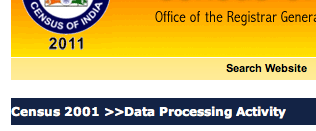
- the breadcrumb style navigation is only for appearances — the links don’t really work
- It says “Census 2001″!!!!
- the <title> anchor says “Evolution of Data Processing”. There’s no indication of the title on the page itself. Instead, it says “Preparation for the 2011 census.”
- Best viewed in 1024×768? Wow.
- None of the foreign language links at the bottom of the page work. It would be trivial to link to a Google-translated page.
- The header image or text don’t link to the Census home page. This is really basic stuff. I wonder if any of the developers building the website have actually used it.
- Most of the links on the Census home page are “under construction.”
Anyways, I don’t want to waste this post on nitpicking. After all, the issues at stake here are considerably more serious than web design. Without further ado, here are the key facts:
- This is the 15th census. The first one took place in 1872.
- I couldn’t get any information about how the previous censuses were conducted, but this time around the Indian Government is aiming to record each and every one of the 1.2 billion individuals. Thats a really lofty goal.
- This Census is also being used to piggy back another significant project: the construction of a National Public Registry (NPR). The NPR will contain some key stats about everyone in India. The NPR will also be used to generate biometric IDs for all Indians at some point.
- For the first time in Census history, some NGOs will be involved in the training phase.
- A lot of geo-spatialization technologies are in play. The only article I could find was this.
- Another first: this Census will be collecting some data on basic sanitation, drinking water etc.
- The 2001 census employed roughly 2 million “enumerators” (data collection personnel). This census will undoubtedly require more.
The FAQ has several interesting nuggets:
The information collected about individuals is kept absolutely confidential. In fact this information is not accessible even to Courts of law.
Once this database has been created, biometrics such as photograph, 10 fingerprints and probably Iris information will be added for all persons aged 15 years and above.
The issue of Cards will be done in Coastal Villages to start with. After this the coastal Towns will be covered and so on till the entire country is covered.
35 questions relating to Building material, Use of Houses, Drinking water, Availability and type of latrines, Electricity, possession of assets etc. will be canvassed.
Like I said earlier, these are lofty goals and this is a massive effort. But there’s so little information out there. I have a lot of questions and concerns. For one, the construction of the NPR poses a huge privacy risk. How is the Government going to ensure that corrupt officials don’t sell out the data to whoever pays the right price? What kind of audit policies and procedures are in place such that a neutral third-party can attest to the integrity of the entire process? Who all within the government will be able to look up my data? If the Government is going to store the biometric data as well, aren’t they constructing a gold-mine of identity-theft ammunition?
Digging around for more information, I found this fascination presentation (linked off of the United Nations Statistics Division). The PPT claims that it was prepared by someone from within the Census organization, but I can’t vouch for its authenticity.
I really hope that a lot more information on the technology behind the Census comes out in the coming months. The news channels in India should take some time out from reporting on tabloid/gossip issues and focus some energy on something that will impact every single Indian.